
Summarize with
Go look at the south side of your house right now. If you have been in Arizona longer than five or six years without repainting, then there is a decent chance you will see faded color with a chalky film. The sun here is relentless.
People who moved from somewhere like the Pacific Northwest or the Great Lakes are usually the most shocked by how fast paint breaks down in Arizona. All that rain finds its way behind any weakness in the coating and starts doing damage you would not notice for months.
So when we talk about exterior painting services in Arizona, we’re talking about protecting the structure of your home, not just changing the color.
This Arizona residence painting guide covers how the whole thing works: the local rules, when to schedule, what the process actually looks like, and some things you’ll want to know before you hire anyone.
If you’re already past the research phase and just want somebody to come look at your place, call Local Painters (Surprise, AZ) at 602-775-3019. We’ll give you a straight answer over the phone.
Why Arizona Homes Need Regular Exterior Painting Services
The UV index stays high for months without much of a break, and what that does to paint over time is eat through the resin binders that hold everything together. When you invest in professional exterior painting services, proper surface preparation and quality materials help protect your home from these harsh conditions. When you lose the resin, the pigment turns into powder.
You’ve probably seen it yourself. Rub your hand on the wall and your palm comes away with a white or grayish film. Once you’re at that stage, the paint isn’t doing its job anymore. Moisture gets through. And in a state where you’ll have half a dozen heavy monsoon storms between July and September, moisture is the real enemy.
Rain doesn’t just sit on the surface. It finds cracks, gets behind peeling edges, and works on the stucco underneath. By the time you see water stains or feel soft spots in the wall, you’re looking at more than just a repaint. You’re looking at stucco repair, and that gets expensive.
Keeping up with your paint schedule is one of those boring maintenance things that saves you real money down the road. Nobody gets excited about it. But putting it off always costs more in the end.
Exterior House Painting Tips Arizona
Most Arizona house painting rules bump up against three separate sets of rules, and each one can cause real headaches if you ignore it.
HOA Color Approval
A big chunk of homes in Arizona (somewhere around 30 percent of all owner occupied properties statewide) sit inside a planned community with an architectural committee. In areas like Surprise and the broader West Valley, the number is probably higher. A lot of those neighborhoods were built out in the early to mid 2000s, and almost all of them came with HOA governance already in place.
What this means for you: you can’t just go buy a gallon of whatever catches your eye at the hardware store. Your HOA likely has an approved color palette, and around here those palettes run heavy on desert neutrals. Think beige, sand, a warm gray, maybe terracotta or off white. Some HOAs will let you use a bolder accent on a front door or some trim work, but the body of the house pretty much has to match what’s on their approved list.
To get approval, you’ll need to dig into your CC&Rs (that stands for Covenants, Conditions, and Restrictions) and find the part about exterior modifications. Then you fill out the application for the Architectural Control Committee. Color choices, paint brand, contractor info. You submit it and then you wait. Figure two to four weeks. Could be longer if the committee only meets once a month.
And you do need to wait. I can’t stress this enough. The Arizona Planned Communities Act gives your HOA the legal authority to make you repaint at your own cost if you skip the approval step or pick a color that’s not on the list. People think they can just go close enough and nobody will notice. The HOA notices.
One workaround that saves time: a lot of Sherwin Williams and Dunn Edwards stores around the West Valley keep color scheme files for specific local subdivisions. Saves you from having to track down the HOA management company for a copy.
Contractor Licensing Through the Arizona ROC
Arizona doesn’t mess around with contractor licensing. If a painter is doing a job worth $1,000 or more (and most full exterior repaints blow past that number easily), they need an active license from the Registrar of Contractors, which everybody calls the ROC. The residential painting classification is C-34. To get it, the qualifying person on the license needs at least four years of trade experience, has to pass a trade knowledge exam and has best exterior house painting tips for Arizona households.
This isn’t just bureaucracy. If something goes wrong on a job done by an unlicensed painter, you have very few options. The ROC has a Residential Contractors Recovery Fund specifically for situations where a licensed contractor does bad work or walks off the job. But unlicensed? You’re out of luck. Spend two minutes on the ROC website and look up whoever you’re thinking about hiring. It’s one of the easiest things you can do to protect yourself.
EPA Lead Paint Regulations for Older Homes
This one applies mainly to older properties. If your house was built before 1978, any painting work that touches more than 20 square feet of exterior surface falls under the EPA’s Lead Renovation, Repair, and Painting (RRP) Rule. The firm has to carry EPA certification, a trained renovator has to be present, and the work has to follow lead safe practices.
The penalties for blowing this off are steep. Fines in the thousands, and in the worst cases, the EPA has forced companies to fund multimillion dollar abatement projects. You can see the full breakdown on the EPA’s RRP Rule page.
For what it’s worth, most Surprise homes were built in the ’90s and 2000s, so lead paint is unlikely to be your issue. But there are plenty of older homes scattered around other parts of the Valley where this comes into play.
Best Time to Book Exterior Painting Services
One of the biggest questions homeowners ask is how to paint a house in Arizona without the finish fading too quickly. The answer starts with choosing the right season, using quality materials, and preparing the surface properly before any paint goes on.
For paint to bond and cure the way it’s supposed to, you need air temperature between 50 and 85 degrees, low humidity, and a dry surface. The best time to paint a house in Arizona is listed below.
Fall (September through November):
This is when most people paint, and for good reason. The monsoon rains wrap up by mid September (usually), highs come down into the 70s and 80s, and the humidity drops.
October is probably the single best month for exterior paint work in the entire state. Crews can work all day. Paint cures the way it should. Everybody else is trying to book the same month. If you want a fall paint job, reach out to your contractor in August at the latest.
Spring (February through April):
The other good window. Mornings can feel a little chilly, low 50s sometimes, but by 10 or 11 AM the temperature is where you want it. Dry air, barely any rain. April is great.
Just don’t push into late May or you’ll be fighting 95 to 100 degree afternoons, and the quality of the job drops when crews have to race the thermometer.
House Painting Process in Arizona
Understanding the House Painting Process in Arizona puts you in a much better position to tell whether your contractor is giving you the best or not.
Residential Painting Planning
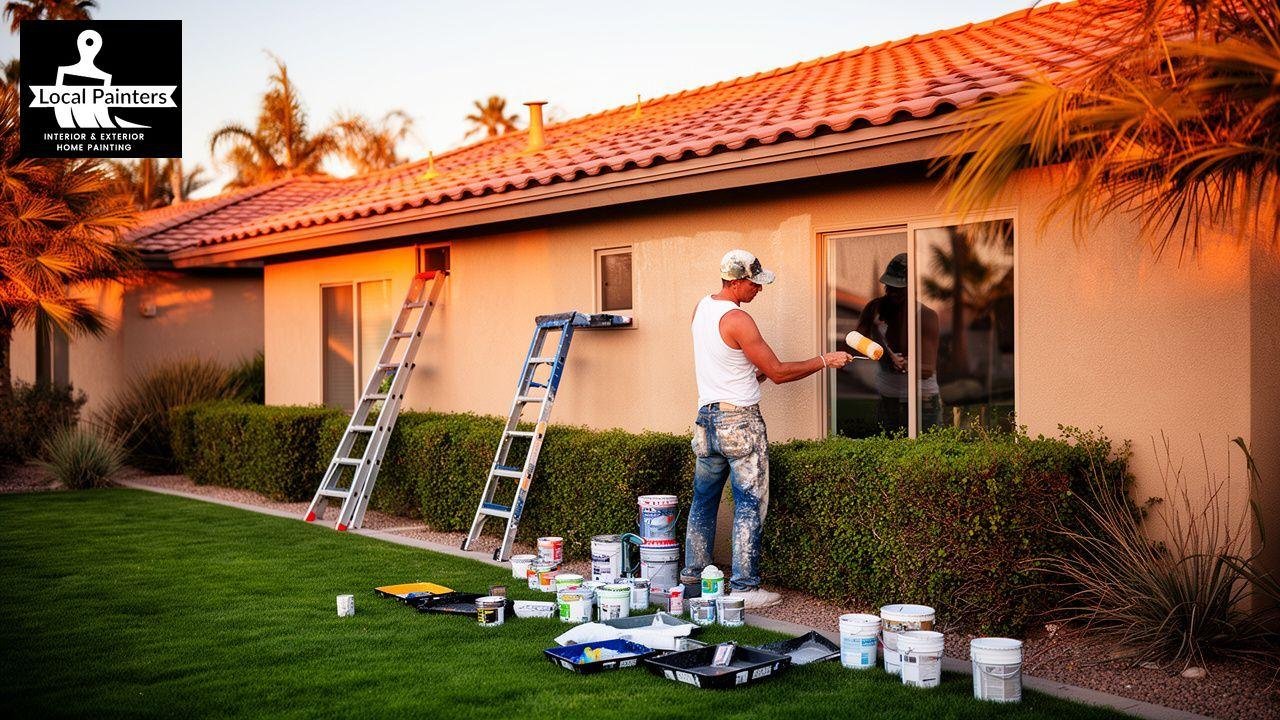
Prep work is the biggest piece of the job. We’re talking roughly 60 percent of total project hours on a standard West Valley stucco home. A lot of residential painting preparation in Arizona surprises homeowners when they see the crew spending two full days before a single coat of paint goes on, but this is the part that makes or breaks the job.
It kicks off with a full walk around. The crew goes over every wall looking for stucco cracks, peeling or flaking paint, moisture stains, busted caulk around window frames and doorways. Anything that needs patching gets addressed now. Cracks wider than a hairline usually get filled with an elastomeric caulk or a stucco patching compound, depending on the size.
Next up is pressure washing, and this part is almost comically satisfying. Every home in Arizona has a layer of fine dust and caliche that builds up so gradually you forget it’s there. It all has to come off. Paint does not stick to a dirty wall. Once the house is washed, you wait. Twenty four to forty eight hours for drying, with a target of under 15 percent surface moisture before anyone picks up a roller.
After drying, it’s masking time. Windows, light fixtures, door hardware, house numbers, any plants growing up near the foundation. Tape and plastic on everything. It’s tedious work, and there’s no way around it. Poor masking shows up in every paint line on the finished house.
Final Inspection in Exterior Painting Services
Primer goes on first: bare stucco, patched areas, any spot where the old paint has chalked all the way through. People underestimate primer. It’s what the topcoat grabs onto. Skip it on bare or heavily chalked stucco (and plenty of contractors will try to skip it), and the topcoat starts peeling within six months to a year. We’ve seen it over and over.
After the primer cures, the topcoat goes on. Most exterior painting services around Arizona use 100 percent acrylic latex. The reason is flexibility. Stucco expands and contracts constantly as surface temperatures swing 40 or 50 degrees between dawn and the middle of the afternoon. Acrylic moves with that swing instead of cracking against it. Sherwin Williams Duration and Dunn Edwards EverShield are two names you’ll hear a lot if you talk to painters around here. Both carry UV resistance ratings and manufacturer warranties in the range of 10 to 15 years when they’re applied at the right thickness.
Reputable Arizona House Painting Guides do two topcoats over the primer as a standard. New stucco or badly faded surfaces might need a third. Each coat goes on at a specific mil thickness (your contractor should know what the manufacturer recommends), and there’s a dry time between coats you can’t rush. Rushing dry time is one of the most common ways a job gets compromised without looking obviously wrong right away.
Final step: the walk through. You go around the house with the crew and look at everything. Even coverage, clean lines where paint meets trim, consistent color from one wall to the next. Check for drips, runs, and holidays (holiday is trade slang for a spot the roller skipped over). If you see something, say something. It’s much easier to fix now.
Pick the Right Paint
The paint you choose matters a lot in painting a house in Arizona’s climate. What you’re after is a formula with high resin content and strong UV resistance. Budget paints try to make up for less resin with more fillers, and you can tell the difference after about two summers. Color fades, chalking starts, and you’re back where you began.
On the regulatory side, the EPA limits volatile organic compound (VOC) content in architectural coatings through its AIM rule. The federal numbers are 250 grams per liter for flat and 380 grams per liter for nonfat formulas. Most name brand paints sold in Arizona already sit below those thresholds, so this shouldn’t be a factor in your buying decision.
Ensure Safety on the Job Site
Two story homes especially bring real safety considerations into the picture. OSHA’s fall protection requirements kick in at six feet above a lower level, per 29 CFR 1926 Subpart M, which means harnesses, guardrails, or personal fall arrest setups depending on the situation. Professional exterior painting services factor this into their operations.
Respiratory protection matters as well. Sanding old paint produces fine airborne dust, and some coatings release compounds that require proper filtration. OSHA’s PPE standards under 29 CFR 1926 spell out what crews need for respirators, eye protection, and head gear.
When your contractor carries a valid ROC license and active insurance, these protocols are already baked into how their people work. It’s not something you should have to ask about, but verifying the license and workers’ comp upfront ensures you’re not on the hook if something goes wrong on your property.
Often Missed Part in Exterior Painting Services
To reap the most benefits, schedule your paint in a way that it doesn’t get affected within just a year,
→ Start early in the morning.
Even during the cooler months, wall surfaces that face the afternoon sun heat up surprisingly fast. Most experienced crews start rolling by 7:00 AM and follow the shade around the house as the day goes on. East walls in the morning, west walls before the sun swings around. It makes a visible difference in the finish quality.
→ Keep an eye on wind.
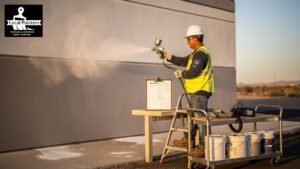
Dust storms get all the attention, but even a moderate 15 mile per hour breeze during spray work pulls overspray sideways and blows grit into wet paint. A morning that looks calm and perfect for painting can turn windy by early afternoon. Crews that spray need to watch the forecast closely.
→ Check your caulk before painting.
This one catches people off guard. Caulk around windows, door frames, and anywhere stucco meets a different material dries out and shrinks in Arizona heat. Caulk that’s only a couple years old can already have tiny gaps in it. Thirty minutes of recaulking before the job starts can prevent water from getting behind the new paint later.
→ Get the warranty on paper.
The manufacturer warranty on the paint product itself and a workmanship warranty from the contractor covering how the work was done. If the painting company hesitates to give you their warranty in writing then take that as a red flag and keep looking for the best.
→ Build a paint file and keep it.
Your HOA color approval, the brand and color codes you used, contractor license number, warranty documents. Stick it all in a folder somewhere. You will need this information later, whether it’s for a touch up job in a few years, selling the house, or disputing an HOA violation notice about a color they already approved. Residential painting services done by a quality crew will include this kind of documentation, but it never hurts to keep your own copy.
Trusted Source for Exterior Painting Services
Painting a house out here isn’t a one size fits all job. The climate dictates the paint, the schedule, the prep method, all of it. A crew that’s worked on hundreds of stucco homes in the West Valley is going to spot problems and avoid shortcuts that someone less familiar with the area might miss entirely. Exterior painting services handled properly buy you a decade or more before the next repaint. Corner cutting puts you back at square one in four or five years.
Local Painters holds the ROC licensing, carries the insurance, and has the local experience to stand behind their work. You can call them for an estimate, or just to ask a question about what your house needs. The number is 602-775-3019, or email localpaintersaz@gmail.com. Your stucco is already out there soaking up Arizona sun every day. Better to deal with it on your schedule than wait until the damage decides for you.
1. Do I need HOA approval before painting my house in Surprise, AZ?
Almost certainly. The vast majority of Surprise neighborhoods are governed by an HOA, and exterior painting falls squarely under their architectural review process. Submit your colors, get the approval in writing, and keep a copy. Skipping this step can lead to fines and a forced repaint at your own expense.
2. How often should I repaint my home’s exterior in the Surprise, AZ area?
Most stucco homes need it every five to seven years, but that depends on which direction your walls face and how much direct sun they get. South and west sides usually fade out first. You’ll know it’s time when you see chalking or when the color looks noticeably washed out.
3. Does my painting contractor need a license to work in Surprise, AZ?
Yes, if the work is worth $1,000 or more. Arizona requires a C-34 residential painting license from the Registrar of Contractors. You can check any contractor’s status online at the ROC website. Takes about two minutes and saves a lot of potential trouble.
4. What is the estimated cost of exterior painting for a home in Surprise, AZ?
There’s no useful one size fits all number because it depends on square footage, how many stories, stucco condition, paint choice, and whether repairs are needed. The honest answer is that you need an in person estimate. Contact Local Painters at 602-775-3019 for a transparent pricing breakdown and an approximate rate for your specific property.
5. How long does an exterior paint job take from start to finish?
For a single story stucco home in decent shape, three to five working days is a reasonable expectation. That covers pressure washing, prep, priming, two topcoats, and cleanup. Two story homes or ones needing significant stucco repair can push closer to seven days or more.
6. Can I paint the exterior of my house myself, or should I hire a professional?
Depends on the scope. Touching up a section of peeling trim? Sure, you can handle that. Repainting the entire exterior involves pressure washing, crack filling, priming, rolling or spraying at height, and getting clean lines around dozens of features. Professional crews have the equipment, the scaffolding, and the muscle memory from doing this every week.
7. What type of exterior paint holds up best in the Arizona climate?
100 percent acrylic latex with UV inhibitors and high resin content. Sherwin Williams Duration and Dunn Edwards EverShield are the two names that come up most often for Arizona work. Both handle UV exposure and extreme heat well, and when applied properly they can go 10 to 15 years between jobs.
8. Does rain or humidity affect exterior painting, and how do I plan around it?
Absolutely. Paint needs a dry surface and humidity under 70 percent to cure right. Arizona’s monsoon season runs roughly June through September and brings unpredictable bursts of heavy rain. Fall and spring are the safest windows to schedule exterior work because conditions are dry and predictable.
Sources
- Arizona Registrar of Contractors. “License Classifications.” roc.az.gov. https://roc.az.gov/license-classifications
- U.S. Environmental Protection Agency. “Enforcement Alert: EPA Enforces Lead Renovation, Repair, and Paint Regulations Against Violators.” epa.gov. https://www.epa.gov/enforcement/enforcement-alert-epa-enforces-lead-renovation-repair-and-paint-regulations-against